The Human Use of Human Beings
Norbert Wiener
Wiener is an old fashioned capital L Liberal that pulls from literature, history of science, philosophy, and religion to try to grasp the knock-on effects of the coming computer revolution. For a sense of historic scale, this book was released only 5 years after the first programmable digital computer, the ENIAC, was built. Famous for catching on fire and destroying it's own vacuum tubes every time it was turned on or off. The first transistor computer was still 3 years off. Information theory as a field is being born at the moment this book is being written. ARPANET is still 20 years from being born. Extrapolating out from his own time, where computers are just beginning to produce useful results for printing out pre-calculated tables he genuinely considers what the extent of computer use could look like. For him the underlying limits are things like: How much sensing data can the computer take in about the world around it? How sophisticated of a feedback system can a computer run on this data, on how far of a timeline and on how subtle of a level can previous input(as well of previous output) affect future action? What separates a simple feedback from a complex feedback in terms of what we see in the output? What separates a complex feedback mechanism, if we built one with the ability to self-modify, from learning? How large is that gap? Would we even recognize one compared to the other? As more sophisticated computers are built, what role can we expect them to play in the economic sphere, in the social realm, or politically? What are the effects they will have on our education, how will they change our views and legal handling of intellectual property?
All of these questions are handled with serious consideration, with technical and mathematical supplement kept to a minimum. What these transformations might mean to our society and to our lives, and what their prerequisites are, are more usefully minted from a closer look at our past, in recorded history, and in our longer term biological history, much of which we must do with very inexact information, when looking back on the development of speech.
"I am writing this book primarily for Americans in whose environment questions of information will be evaluated according to a standard American criterion: a thing is valuable as a commodity for what it will bring on the open market. This is the official doctrine of an orthodoxy which it is becoming more and more perilous for a resident of the United States to question. It is perhaps worthwhile to point out that it does not represent a universal basis of human values: that it corresponds neither to the doctrine of the Church, which seeks for the salvation of the human soul, nor to that of Marxism, which values a society for its realization of certain specific ideals of human well-being. The fate of information in the typically American world is to become something which can be bought or sold."
"In all important respects, the man who has nothing but his physical power to sell has nothing to sell that is worth anyone's money to buy."
It's dazzling when you read someone making calls about what will happen in the future. The further out into the future, and the more on target, the more impressive it is. Then, it starts to seep backwards in your mind, let me see what else this guy talked about, maybe he's right about more stuff, how did he come to arrive at having Correct Thoughts (TM), can I replicate this Correct Thought Process and start having My Own? Sure, sometimes you can do that, and sure it is impressive, I'm impressed. But even more dazzling to me, is seeing a Computer Ideologist engaging with the works of the western canon, engaging with the Humanities, engaging with small-ball politics and Large-Ball Politics. What a sad state of affairs we're in with today's computer ideologists. Their standard-bearers would tell you that all of that stuff is the domain of under-employed adolescents, and that the computer (and by extension they) are apolitical.
Growth Of The Soil
Knut Hamsun
The Norge yeoman takes off into the wilderness to stake his claim and till the soil. Unfortunately in his long and toilsome life a handful of occasions arise where he must confront the horrors of modernity. He lacks a deed to his own dirt farm, but the tax collector surveys his plot and cuts him some slack on his back-taxes. The telegraph company starts putting up poles through the area. His yokel wife starts getting a little too uppity about her ability to book read. For the most part these confrontations resolve with our dirt farmer going 'no thank-you, no modernity for me' and that's that. Eventually, he ends up finding himself won over. He is old, and spent his entire life building up his homestead and his family, and with the wisdom that comes with those decades of toil, he turns away from pure Ludditism, and decides to outfit himself with a tractor. The machine is so beautiful and there is nothing wrong with a gleaming labor saving gizmo. This a practical and measured middle ground to negotiate with the unceasing march of progress. Unlike his aforementioned wife's book-reading, or his wretched genteel urbanite son's obsession with outfits. Those are a step too far.
How about this: I'm staring into the horrifying gaping maw of modernity every day, asshole! I don't get to say 'no thanks!'. It sucks!
I did like the book, I read it on the plane on the way to my own family's dirt farm and it really helped set the tone. But I'm not being tricked by the line I'm being sold. Yeomanism is going away buddy, you're either getting turned into a serf, or proletarianized. Pick your poison.
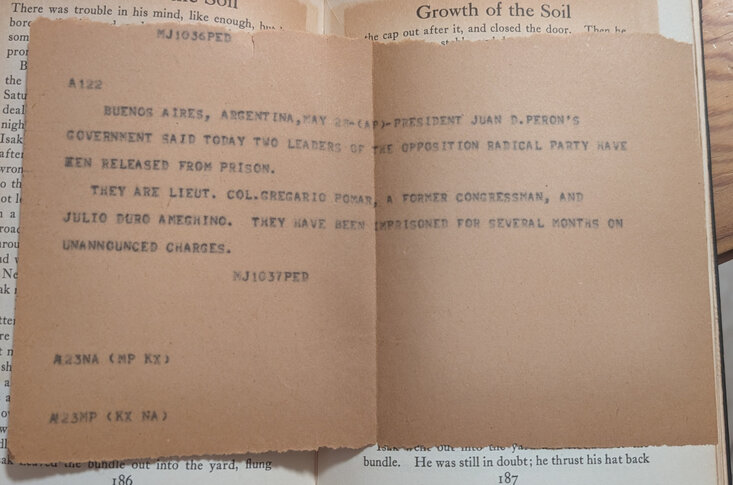
My copy of this book was published in 1921 and I found my favourite piece of book treasure nestled between the pages, an honest to god folded up telegraph right around the part of the book where the character is getting telegraph wires put through his farm.
Baron Wenckheim's Homecoming
László Krasznahorkai
I was having such a rough day when I bought this, I can't remember why but I ended up completely butchered my small-talk the nice book-monger. Who warned me that László's other book that I had set back down was moving more copies. The story rapidly switches between characters, every paragraph is told from the point of view of a different townie in the Hungarian back-country, with more important townies getting circled back to at various points. Society is in a slow drawn out collapse, and then suddenly all at once fails over on itself, and is destroyed. That doesn't really matter for most of the story, which has two main absurd plot points, and then rotates through dozens of B/C/D/E plots of lesser or greater importance to the depressed residents of this insignificant border town. I liked it well enough that I'll go back to that store and buy the one the book-monger suggested and look them in the eyes and smile and hold up my end of the conversation[1]. But I had a 8 hour flight coming up so I bought the fat one I initially picked up, instead of the thin one the expert recommend.
[1] Editor's note I went back and absolutely floundered, I was squirming around like a bug in there.Free Software, Free Society (Third Edition)
Richard M. Stallman
Completely on the money.
While I was reading this book I purchased a Google TV Streamer (™) to try to get around how absolutely shit my smart TV is at pretty much everything. I was a gen 1 chromecast owner, and I let my previous good experiences with their hardware cloud my judgements. To my furious surprise, this $150 piece of hardware is useless without a gmail account. Dogshit. I rolled my eyes and figured whatever, I'll go on the computer and create a gmail account and waste 5 more minutes of my life. Turns out, you can't do that anymore! It must be that everyone already made their gmail account 15 years ago, because you can only make a new one by tying it to a phone number, and I'm the last person to learn this news. And, that phone has to attest back to big google, so no scribbling in J.G. Wentworth's number into the web form! 72 hour rolling apoplectic blackouts.
I'm buying the next cheap office mini-pc I find at a garage sale and performing whatever nightmare incantations are required to get linux (GNU/Linux, etc) to operate like a set-top box.
Political Writings
Jean Jacques Rousseau
A Discourse on the Origin of Inequality
A Discourse on Political Economy
The Social Contract
"You know, we're living in a society! We're supposed to act in a civilized way!" ~ George Costanza
The above quote can serve as an adequate substitute for the source material. The above quote can also work double-time and be stretched to cover Kant's categorical imperative. This does not mean these are interchangeable concepts, it means George Costanza is a byproduct of the Enlightenment.
Rousseau appears to entirely give up the ghost he's chasing in Origin of Inequality by the time he's writing The Social Contract. In the first he's taking a look at what's given up in the name of collective, civil society and rather than saying, now we're enlightened and literate the deal is good, or the pessimistic view: the deal is bad, he wonders if we didn't get swindled somewhere along the way. It seems by necessity this would lead to the discussion in the Social Contract, but ends up being given a wide berth in the later work.
For most of it's page-count the Social Contract is a rather boring revamp of Plato's Republic (and at times, chunks of Crito), but there are some points where Rousseau really ends up asking some of the big fundamentals.
Slavery to him is clearly nothing more than a social vestige of natural law's right to kill the conquered. For Rousseau, the institution cannot be properly shoehorned into liberal society with the favoured post-hoc justification of the day. Apologists legitimize it as a social exchange the slave makes where they bargain away their liberty to be allowed to keep their life. Rousseau flat out views this as nonsense, and says that the hollowness of this argument is apparent in the real institution of slavery treating the status as something that can be passed on to the children of slave. But he also sees his own argument as it swings around and hit him in the back of the head.
The whole basis of the social contract is that the liberty of the great masses can in fact be bargained in just this way, so long as both sides of the transaction are able to choke down the terms. Why? Where is the reversal from individual to group? Rousseau realizes that he's staring into the sun and has to look away here, to go back to talking about the infinite gradations and combinations of middle management possible in the Platonic Bureaucracy.
Later on he makes a point that could have gone towards fleshing out the above. In his view, the social contract can only be valid by having, regardless of government-form some sort of regularly scheduled plebiscite assembly with two votes. First, a vote of potential recall on the entire structure of the current government-form, the second a vote of recall for the current politicians. From this position it's not a big hop skip and a jump to say that the slave doesn't get to renounce his servitude, because a surrender of freedom cannot be permanently enforced. This is what differentiates it from a contract, which must hold in the face of a single party's renunciation, and being an economic tool nothing which can affect your freedom can ever be a valid part of it's conditions in the first place.
A Wizard of Earthsea
Ursula K. Le Guin
The only fantasy novel I've liked other than Tolkien's. Maybe books don't need to be 700 pages sometimes. Maybe reviews don't need to be 500 words long. Maybe you should have a second name because your real one will let people do spells on you. Maybe you should have a second name because your real one kind of sucks.

